前言
第八讲介绍了当 goroutine 运行时间过长会被抢占的情况。这一讲继续看 goroutine 执行系统调用时间过长的抢占。
系统调用时间过长的抢占
看下面的示例:
 1func longSyscall() {
 2	timeout := syscall.NsecToTimeval(int64(5 * time.Second))
 3	fds := make([]syscall.FdSet, 1)
 4
 5	if _, err := syscall.Select(0, &fds[0], nil, nil, &timeout); err != nil {
 6		fmt.Println("Error:", err)
 7	}
 8
 9	fmt.Println("Select returned after timeout")
10}
11
12func main() {
13	threads := runtime.GOMAXPROCS(0)
14	for i := 0; i < threads; i++ {
15		go longSyscall()
16	}
17
18	time.Sleep(8 * time.Second)
19}
longSyscall goroutine 执行一个 5s 的系统调用,在系统调用过程中,sysmon 会监控 longSyscall,发现执行系统调用过长,会对其抢占。
回到 sysmon 线程看它是怎么抢占系统调用时间过长的 goroutine 的。
 1func sysmon() {
 2    ...
 3    idle := 0 // how many cycles in succession we had not wokeup somebody
 4    delay := uint32(0)
 5    ...
 6
 7    for {
 8		if idle == 0 { // start with 20us sleep...
 9			delay = 20
10		} else if idle > 50 { // start doubling the sleep after 1ms...
11			delay *= 2
12		}
13		if delay > 10*1000 { // up to 10ms
14			delay = 10 * 1000
15		}
16		usleep(delay)
17
18        ...
19        // retake P's blocked in syscalls
20		// and preempt long running G's
21		if retake(now) != 0 {
22			idle = 0
23		} else {
24			idle++
25		}
26        ...
27    }
28}
类似于运行时间过长的 goroutine,调用 retake 进行抢占:
 1func retake(now int64) uint32 {
 2	n := 0
 3	lock(&allpLock)
 4	for i := 0; i < len(allp); i++ {
 5		pp := allp[i]
 6		if pp == nil {
 7			continue
 8		}
 9		pd := &pp.sysmontick
10		s := pp.status
11		sysretake := false
12
13        if s == _Prunning || s == _Psyscall {                           // goroutine 处于 _Prunning 或 _Psyscall 时会抢占
14			// Preempt G if it's running for too long.
15			t := int64(pp.schedtick)
16			if int64(pd.schedtick) != t {
17				pd.schedtick = uint32(t)
18				pd.schedwhen = now
19			} else if pd.schedwhen+forcePreemptNS <= now {
20                // 对于 _Prunning 或者 _Psyscall 运行时间过长的情况,都会进入 preemptone
21                // preemptone 我们在运行时间过长的抢占中介绍过,它主要设置了 goroutine 的标志位
22                // 对于处于系统调用的 goroutine,这么设置并不会抢占。因为线程一直处于系统调用状态
23				preemptone(pp)
24				// In case of syscall, preemptone() doesn't
25				// work, because there is no M wired to P.
26				sysretake = true
27			}
28		}
29
30        if s == _Psyscall {
31            // Retake P from syscall if it's there for more than 1 sysmon tick (at least 20us).
32            // P 处于系统调用之中,需要检查是否需要抢占
33            // syscalltick 用于记录系统调用的次数,在完成系统调用之后加 1
34			t := int64(pp.syscalltick)
35			if !sysretake && int64(pd.syscalltick) != t {
36                // pd.syscalltick != pp.syscalltick,说明已经不是上次观察到的系统调用了,
37                // 而是另外一次系统调用,需要重新记录 tick 和 when 值
38				pd.syscalltick = uint32(t)
39				pd.syscallwhen = now
40				continue
41			}
42
43            // On the one hand we don't want to retake Ps if there is no other work to do,
44			// but on the other hand we want to retake them eventually
45			// because they can prevent the sysmon thread from deep sleep.
46            // 如果满足下面三个条件的一个则执行抢占:
47            // 1. 线程绑定的本地队列中有可运行的 goroutine
48            // 2. 没有无所事事的 P(表示大家都挺忙的,那就不要执行系统调用那么长时间占资源了)
49            // 3. 执行系统调用时间超过 10ms 的
50			if runqempty(pp) && sched.nmspinning.Load()+sched.npidle.Load() > 0 && pd.syscallwhen+10*1000*1000 > now {
51				continue
52			}
53
54            // 下面是执行抢占的逻辑
55            unlock(&allpLock)
56			// Need to decrement number of idle locked M's
57			// (pretending that one more is running) before the CAS.
58			// Otherwise the M from which we retake can exit the syscall,
59			// increment nmidle and report deadlock.
60			incidlelocked(-1)
61			if atomic.Cas(&pp.status, s, _Pidle) {                  // 将 P 的状态更新为 _Pidle
62				n++                                                 // 抢占次数 + 1
63				pp.syscalltick++                                    // 系统调用抢占次数 + 1
64				handoffp(pp)                                        // handoffp 抢占
65			}
66			incidlelocked(1)
67			lock(&allpLock)
68        }
69    }
70    unlock(&allpLock)
71	return uint32(n)
72}
进入 handoffp:
 1// Hands off P from syscall or locked M.
 2// Always runs without a P, so write barriers are not allowed.
 3//
 4//go:nowritebarrierrec
 5func handoffp(pp *p) {
 6    // if it has local work, start it straight away
 7    // 这里如果 P 的本地有工作(goroutine),或者全局有工作的话
 8    // 将 P 和其它线程绑定,其它线程指的是不是执行系统调用的那个线程
 9    // 执行系统调用的线程不需要 P 了,这时候把 P 释放出来,算是资源的合理利用,相比于线程,P 是有限的
10	if !runqempty(pp) || sched.runqsize != 0 {
11		startm(pp, false, false)
12		return
13	}
14
15    ...
16    // no local work, check that there are no spinning/idle M's,
17	// otherwise our help is not required
18	if sched.nmspinning.Load()+sched.npidle.Load() == 0 && sched.nmspinning.CompareAndSwap(0, 1) { // TODO: fast atomic
19		sched.needspinning.Store(0)
20		startm(pp, true, false)
21		return
22	}
23
24    ...
25    // 判断全局队列有没有工作要处理
26    if sched.runqsize != 0 {
27		unlock(&sched.lock)
28		startm(pp, false, false)
29		return
30	}
31
32    ...
33    // 如果都没有工作,那就把 P 放到全局空闲队列中
34    pidleput(pp, 0)
35	unlock(&sched.lock)
36}
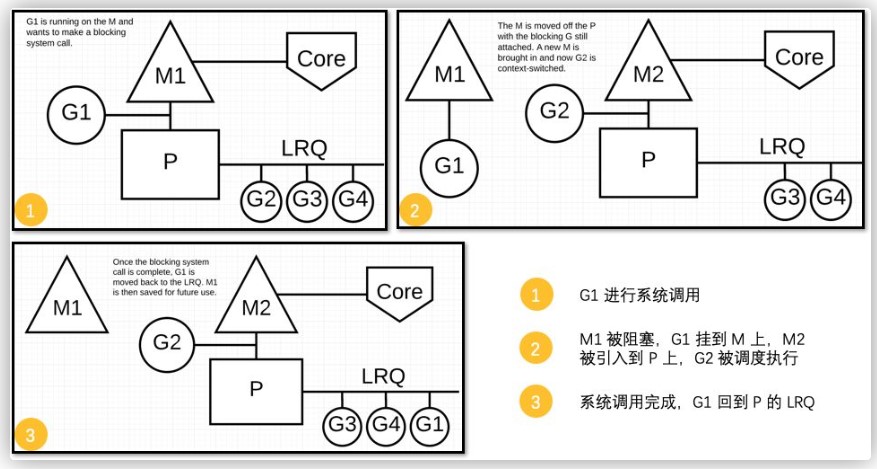
可以看到抢占系统调用过长的 goroutine,这里抢占的意思是释放系统调用线程所绑定的 P,抢占的意思不是不让线程做系统调用,而是把 P 释放出来。(由于前面设置了这个 goroutine 的 stackguard0,类似于 运行时间过长 goroutine 的抢占 的流程还是会走一遍的)。
我们看一个示意图可以更直观清晰的了解这个过程:
handoff 结束之后,增加抢占次数 n,retake 返回:
 1func sysmon() {
 2	...
 3	idle := 0 // how many cycles in succession we had not wokeup somebody
 4	delay := uint32(0)
 5	for {
 6		if idle == 0 { // start with 20us sleep...
 7			delay = 20                  // 如果 idle == 0,表示 sysmon 需要打起精神来,要隔 20us 监控一次
 8		} else if idle > 50 { // start doubling the sleep after 1ms...
 9			delay *= 2                  // 如果 idle 大于 50,表示循环了 50 次都没有抢占,sysmon 将加倍休眠,比较空,sysmon 也不浪费资源,先睡一会
10		}
11		if delay > 10*1000 { // up to 10ms
12			delay = 10 * 1000           // 当然,不能无限制睡下去。最大休眠时间设置成 10ms
13		}
14
15        if retake(now) != 0 {
16			idle = 0                    // 有抢占,则 idle = 0,表示 sysmon 要忙起来
17		} else {
18			idle++                      // 没有抢占,idle + 1
19		}
20    ...
21    }
22    ...
23}
小结
本讲介绍了系统调用时间过长引起的抢占。下一讲将继续介绍异步抢占。